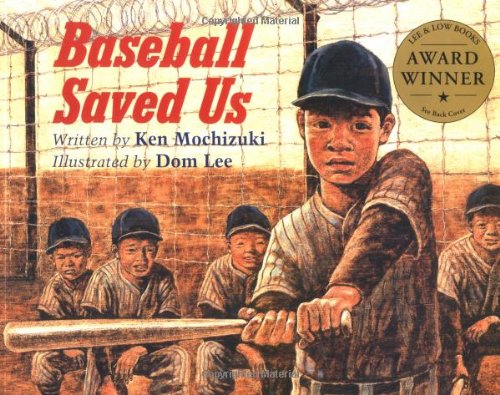
Book Summary:
"Shorty" and his family are sent to an internment camp for Japanese Americans during WWII. As an outlet for the fear, boredom, and frustration that the people are feeling, his father brings everyone together to create a baseball field. Life in the camp is difficult, but baseball gives everyone something to take there minds off the world around them. After leaving the camp, life continues to be be difficult, but some of the things "Shorty" learns while away from home help him to overcome the struggles he faces.
Mochizuki, K., & Lee, D. (1993). Baseball saved us. NY: Lee & Low.
Impressions:
Baseball Saved Us is a simple book, and yet the layers within are more pronounced because of its simplicity. On the surface, the story tells of a young boy trying to make sense of his family being sent to an interment camp. Because the reader sees things through "Shorty's" innocent eyes, the things left unsaid speak volumes about what is happening. There is a good deal of historical information packed into such few pages about the conditions of the camp and how the process stripped the Japanese American families of so many things, both physical and emotional. Their culture and values were tested as they were confined to such a small space with little to keep them occupied.
In addition to the historical aspects of the story, Mochizuki tells a great story of building good in a situation where it seems none can be found. The fact that the Japanese Americans at the camp were able to make a baseball field from next to nothing shows their perseverance and drive to remain human in a situation where everything was being done to make them less than human. "Shorty" did not understand the discrimination he faced outside of the camp, but he was able to use some of his anger and frustration to become a better player. In the end, this helped him when his family moved back home. The story is missing many of the details related to circumstances Japanese Americans faced during WWII, but it is an accessible entry point for readers who might not know anything about what happened.
Professional Review:
Drawing on his Japanese-American parents' experiences, a new author uses his narrator's struggle to become a better, and more accepted, ballplayer to portray a WW II internment camp. Quietly, ``Shorty'' describes his family's sudden removal to the camp in 1942, the grim surroundings, the restiveness his dad hopes to counter by building a baseball diamond. Materials are improvised (uniforms are made from mattress ticking), but the game soon thrives. Still, Shorty is usually an ``easy out'' until anger at the perpetually watching guard inspires him to hit a homer-- whereupon he sees the guard give him thumbs-up and a grin. But the real focus here is the camp and the prejudice that caused it. Back home after the war, Shorty finds friendly teammates but still hears racist taunts when he plays--and still uses the anger he feels to strengthen his resolve and do his best. Using scratchboard overlaid with oils, Lee (who grew up in Korea) provides splendidly evocative art whose somber tones are enriched with luminous color; he's a keen observer of baseball and the camp milieu. Fine debuts for author, illustrator, and publisher. (Picture book. 6-10)
Kirkus (1993). [Review for the book Baseball Saved Us]. Retrieved from
https://www.kirkusreviews.com/book-reviews/ken-mochizuki/baseball-saved-us/
Library Uses:
There is a lot of fear in our society today about people who are different from "us." This book would serve as a great discussion starter on the things that can come from those fears. The story of Japanese Americans is not talked about much, so showing students how multiple people can be affected by war is a good start to instilling within them empathy for others. Hopefully, it will help them to stop and reconsider before making assumptions of people who are from a different race or culture.
Readalikes:
The Bracelet by Yoshiko Uchida
A Place Where Sunflowers Grow by Amy Lee-Tai
Dear Miss Breed by Joanne Oppenheim
Comments
Post a Comment